FitSpresso Reviews: What the Coffee Capsule Contains and What Weight Loss to Realistically Expect
By the Pure Fat Burn Caps Editorial Team · Updated October 2026
Disclosure: this article contains affiliate links. If you buy through them, we may earn a commission at no extra cost to you. It does not change what we write.
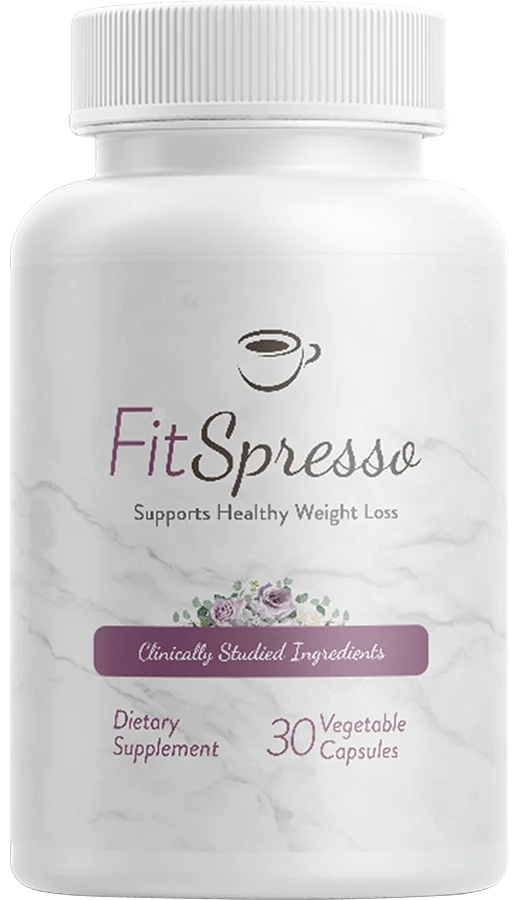
FitSpresso at a Glance
| Form | Vegetable capsules — 1 a day with your morning coffee (30 capsules per bottle) |
| Core ingredients | 5 named: chlorogenic acid, L-carnitine, EGCG (green tea), chromium picolinate, L-theanine |
| Made in | Not stated; the official page says a GMP-certified facility with third-party testing |
| Guarantee | 60 days from purchase; unused bottles returned at your cost |
| Shipping (US) | $9.99 on 1 bottle; free on 3- and 6-bottle bundles |
| Main caution | Taken with coffee — watch total caffeine; green tea extract and chromium need care with liver disease or diabetes medicines |
Few habits are as widespread as the morning cup of coffee, and that is exactly the hook FitSpresso uses. Instead of asking you to give anything up, it asks you to add one capsule to the coffee you already drink and promises that the two together will speed up your metabolism. For anyone tired of complicated diets, that pitch is easy to like.
The question is how much of it holds up. In this review we go through what the official page actually says, how the "coffee synergy" idea compares with the research, what each named ingredient has been shown to do in people, who should be careful with caffeine and certain medicines, and what you pay and get back under the refund policy. We have not used the product; product facts come from the official website and the evidence notes come from public research summaries.
→ See the FitSpresso ingredient list on the official website
What Is FitSpresso?
FitSpresso is a dietary supplement sold for weight management. Each bottle holds 30 vegetable capsules, and the instructions on the official page are short: take one capsule with your morning coffee. The brand says any coffee works, whether brewed, espresso or iced.
According to the official page, the capsules are vegetarian, non-GMO and gluten-free, and contain no added fillers, preservatives, artificial colors or stimulants. The page also says FitSpresso is processed in a GMP-certified facility that routinely undergoes third-party testing. It does not say in which country the capsules are made, and it does not claim an FDA-registered facility, so we will not assume either.
It helps to remember that no dietary supplement is reviewed by the FDA for effectiveness before it goes on sale. Manufacturing standards such as GMP concern quality control and labeling accuracy, not proof that a product causes weight loss.
How FitSpresso Is Said to Work: Claim vs Evidence
The sales story is built around a "fat-burning window": the idea that the body switches between storing and burning fat on a daily rhythm, and that FitSpresso keeps that window open for longer. Coffee is presented as the starter that speeds up metabolism, and the capsule as the booster that makes the effect last all day. The brand calls this combination "super-synergy".
There is a grain of real science underneath. Circadian rhythms do influence metabolism, and caffeine does raise energy expenditure slightly for a few hours. But a small, short-lived rise in calorie burning is very different from steady fat loss. The official page does not cite a clinical trial of the FitSpresso capsule itself, and the studies it links to were done on individual compounds, at doses we cannot compare because the label amounts are not published on the sales page.
The page also tells long personal transformation stories and suggests the strongest results appear around the fifth or sixth month. Those stories are marketing, not typical outcomes. A realistic expectation for any weight management supplement is a small effect at best, which only shows up alongside changes in eating, movement and sleep.
Why Some FitSpresso Reviews List Different Ingredients
If you read several FitSpresso articles you may notice they disagree about what is in the bottle. Some older pages mention ingredients such as berberine, resveratrol, zinc or alpha lipoic acid, others mention garcinia or caffeine anhydrous. The current official sales page names five ingredients, listed below, and says nothing about the others. Because formulas and pages change, the safest approach is to read the Supplement Facts panel on the bottle you receive and compare it with this list.
FitSpresso Ingredients and What the Research Says
The official page names the five compounds below but does not show a Supplement Facts panel with the amount of each one. That matters, because in nutrition research the dose usually decides whether anything happens at all.
1. Chlorogenic Acid (CGA, from Coffee Berry)
Chlorogenic acids are polyphenols found in coffee, especially in green, unroasted beans, and green coffee extract became a popular weight loss ingredient around 2012. A 2011 meta-analysis of green coffee extract trials found a small average weight difference compared with placebo, but the authors described the studies as few, short and of poor quality. One heavily promoted trial was later retracted. Coffee itself already contains chlorogenic acids, so it is unclear how much an extra dose adds.
2. L-Carnitine
L-carnitine carries fatty acids into the mitochondria, where they are used for energy. The NIH Office of Dietary Supplements notes that healthy people make enough carnitine on their own. A 2016 meta-analysis found that adults taking carnitine lost about 1.3 kg (roughly 3 pounds) more than those on placebo over the course of the trials, with the effect fading the longer the studies ran. It is a real but modest effect.
3. EGCG (Epigallocatechin Gallate from Green Tea)
EGCG is the main catechin in green tea. A Cochrane review of green tea preparations found that weight loss in adults with overweight was small and not statistically or clinically meaningful in most well-run trials. Concentrated green tea extracts have also been linked to rare cases of liver injury, and European food safety regulators have flagged intakes of 800 mg of EGCG a day or more as a concern. FitSpresso does not publish its EGCG amount, so this is worth asking about if you have any liver condition.
4. Chromium (as Chromium Picolinate)
Chromium is a trace mineral that helps insulin do its job. A Cochrane review of chromium picolinate for overweight and obesity concluded that the evidence was of low quality and showed no convincing benefit on body weight; the NIH fact sheet describes the differences seen in trials as too small to matter in practice. Chromium can add to the effect of diabetes medicines and may affect how some thyroid medicine is absorbed.
5. L-Theanine
L-theanine is an amino acid from tea leaves. Small human studies suggest that taking it with caffeine may improve attention and soften some of the jittery edge that coffee gives certain people. That is the most plausible role it plays here. There is no meaningful evidence that L-theanine causes weight loss.
Taken together, the formula is built from familiar, widely studied compounds. None of them, on its own, has shown more than a modest effect on body weight, and the official page gives no doses that would let you match them to the studies.
Want to see the full FitSpresso offer and today's bundle prices? Check the official site.
Visit the Official FitSpresso Website →Pros and Cons of FitSpresso
Pros
- Very simple routine: one capsule with the coffee you already drink
- Ingredients that have at least been studied in humans
- Described as vegetarian, non-GMO and gluten-free, with no added stimulants
- GMP-certified facility and third-party testing mentioned on the official page
- Free US shipping on the 3- and 6-bottle bundles
- 60-day money-back guarantee with a phone line open seven days a week
Cons
- Ingredient doses are not shown on the sales page
- Evidence for weight loss from each ingredient is weak or modest
- No published trial of the finished product
- The sales page relies on dramatic personal stories
- Different sections of the page show different prices
- Return shipping is paid by the customer
Who Might Consider FitSpresso (and Who Should Not)
FitSpresso is a reasonable fit for adults who:
- already drink coffee every morning and tolerate it well
- want a low-effort routine to sit alongside sensible eating and regular activity
- accept that any change on the scale is likely to be small and gradual
- are comfortable using the 60-day refund window if it does not suit them
It is not a good idea without a doctor's input if you are pregnant, nursing or trying to conceive; are under 18; have liver disease; have diabetes or take glucose-lowering medicine; take thyroid medicine; use prescription weight loss drugs such as GLP-1 medicines; or have heart rhythm problems, high blood pressure, anxiety or insomnia that coffee already makes worse. The official page itself advises anyone who is pregnant, nursing, on medication or living with a medical condition to talk to a physician first.
Safety, Side Effects and the Caffeine Question
No serious side effects have been publicly linked to FitSpresso as a finished product, and the official page does not list any. The individual ingredients are generally well tolerated in studies; the most commonly reported issues are stomach upset, nausea or headache.
The capsule is described as stimulant-free, but it is designed to be taken with coffee, so caffeine is part of the routine. The FDA says that around 400 mg of caffeine a day — roughly four or five cups of brewed coffee — is not generally linked to harmful effects in healthy adults, though sensitivity varies a lot. If you notice a racing heart, jitteriness, heartburn or poor sleep, cut back on coffee rather than adding more.
Two ingredients deserve extra attention. Green tea extract has been linked to rare liver injury, so stop and see a doctor if you notice dark urine, yellowing of the skin or eyes, or pain in the upper right abdomen. Chromium may lower blood sugar slightly, which matters for anyone on insulin or other diabetes medicines. Showing the bottle's label to a pharmacist is a quick way to check for interactions.
How to Use FitSpresso
The official instructions are one capsule with your morning coffee. The page does not say whether to take it with food or give a maximum daily amount, so stick to one capsule a day. Because the research on its ingredients ran for weeks to months, judge it over about three months rather than a few days, and track something simple, such as weekly weight and waist measurement, so you can make an honest decision before the 60-day refund window closes.
Healthy weight loss is usually gradual. Public health guidance suggests about 1 to 2 pounds a week is a realistic and sustainable pace, and no capsule changes that math on its own. The routine works best as a reminder to keep the rest of the morning sensible: a protein-rich breakfast, coffee without heavy sugar or cream, and some daily movement.
FitSpresso Price, Shipping and Guarantee
FitSpresso is sold in three packages. The checkout links on the official page correspond to the prices below; another section of the same page shows lower figures, so confirm the total at checkout before you pay.
| Package | What the official page states |
|---|---|
| 1 bottle (30-day supply) | $69 + $9.99 US shipping |
| 3 bottles (90-day supply) | $177 total ($59 per bottle), free US shipping |
| 6 bottles (180-day supply) | $234 total ($39 per bottle), free US shipping |
| Payment | One-time payment, no subscription described |
| Delivery time | Not stated on the official page |
| Guarantee | 60 days from the purchase date |
The refund policy asks you to call 1-877-607-7721 (7 AM to 9 PM, seven days a week) or email support within 60 days of purchase, then mail any unused bottles to the returns address in Aurora, Colorado. You pay the return postage. According to the policy, refunds take about 5 to 7 business days to reach a credit card and 5 to 10 business days for a debit card after processing. Keep your order number and tracking details.
→ Check today's FitSpresso price and bundles on the official website
What We Saw on the Official FitSpresso Order Page (October 12, 2026)
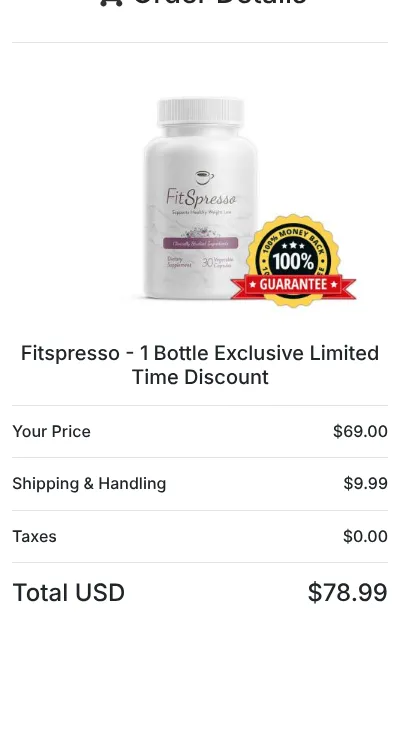
On October 12, 2026 we opened the official order page ourselves and followed the checkout up to the payment step, without placing an order, to record exactly what a buyer sees. The screenshots below are unedited crops from that visit.
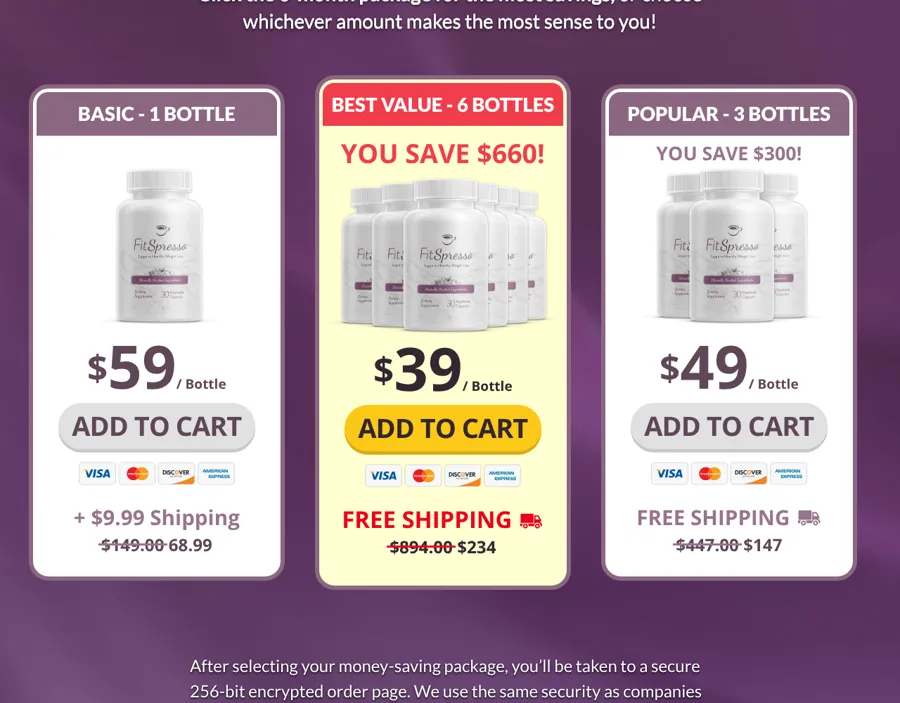
- The order page we reached showed $59 per bottle for 1 bottle ($68.99 with shipping), $49 per bottle for 3 bottles ($147) and $39 per bottle for 6 bottles ($234).
- The checkout pages those same buttons opened showed different totals for two of the three bundles: 1 bottle at $69.00 plus $9.99 shipping ($78.99) and 3 bottles at $177.00. Only the 6-bottle total matched, at $234.00. We repeated the check and saw the same result.
- So on the day we checked, the 1-bottle and 3-bottle checkouts were $10 and $30 higher than the prices on the order page. Before paying, compare the total on the checkout screen with the package you clicked.
- The terms page says refunds can be requested within 60 days from the date of purchase; the contact page lists support@GetFitSpresso.com.
FitSpresso vs Simply Changing Your Coffee Habit
It is fair to ask what FitSpresso adds compared with what you can do with the coffee itself. Plain black coffee has almost no calories and already contains caffeine and chlorogenic acids. The bigger difference for most people comes from what goes into the cup: a large flavored latte or a coffee with several spoons of sugar and cream can carry 200 to 400 calories, every single morning. Switching to a lighter version is free and often has a larger effect on the scale than any capsule.
FitSpresso adds L-carnitine, green tea EGCG, chromium and L-theanine on top of that. Each has a small amount of supporting research, and L-theanine may make coffee feel smoother for some people. Whether that is worth roughly $39 to $69 a month depends on your budget and how much you value the convenience. If you decide to try it, do both: keep the coffee light and use the capsule as the extra, not the main strategy.
Things to Check Before You Order
- Read the Supplement Facts panel on the bottle when it arrives and compare it with the five ingredients named on the sales page
- Confirm the final total on the checkout page, since different sections of the sales page show different prices
- Write down the purchase date — the 60-day refund window starts then, not when you open the first bottle
- Show the label to your doctor or pharmacist if you take any regular medicine, especially for diabetes, the thyroid or weight loss
- Keep unused bottles sealed in case you decide to return them
Where to Buy FitSpresso
FitSpresso is sold through its official website and the official order page linked from it. Bottles listed on marketplaces or by unknown sellers may be old stock or imitations, and they are generally not covered by the 60-day guarantee. Buying from the official page is the simplest way to get the genuine product and keep the refund option open.
Final Verdict
FitSpresso's best feature is convenience. It attaches itself to a habit millions of people already have, uses compounds that have been studied in humans, and comes with a straightforward 60-day refund policy and free shipping on the larger bundles.
Its weaknesses are the missing doses, the lack of a trial on the product itself and a marketing story that promises far more than the ingredient research supports. If you tolerate coffee well, have no liver, heart or blood sugar concerns, and want to try it with modest expectations, it is a reasonable option under the guarantee. Treat it as a small helper next to diet, sleep and movement, not as the thing that does the work.
Frequently Asked Questions (FAQs)
Does FitSpresso really work for weight loss?
There is no published trial of FitSpresso itself. Its ingredients have shown small or inconsistent effects on weight in studies, so expect modest results at best, and only alongside changes in diet and activity.
How do you take FitSpresso?
The official page says to take one capsule with your morning coffee. Each bottle has 30 capsules, which is a one-month supply.
Does FitSpresso contain caffeine?
The capsule is described as stimulant-free, but you take it with coffee. Keep your total caffeine below about 400 mg a day, or lower if you are sensitive.
Is FitSpresso safe with diabetes or thyroid medication?
Ask your doctor first. Chromium can add to the effect of diabetes medicines and may affect absorption of some thyroid medicine, and the label doses are not shown on the sales page.
Is FitSpresso FDA-approved?
No dietary supplement is FDA-approved. The official page says FitSpresso is processed in a GMP-certified facility with third-party testing, which relates to manufacturing quality, not proof of results.
What is the FitSpresso refund policy?
You have 60 days from purchase. Call or email support, then return unused bottles to the Aurora, Colorado address at your own shipping cost. Refunds post in about 5 to 10 business days.
Curious about the current bundles? The official site shows today's prices and checkout total.
Visit the Official FitSpresso Website →References
- Onakpoya I, Terry R, Ernst E. The use of green coffee extract as a weight loss supplement: a systematic review and meta-analysis of randomised clinical trials. Gastroenterol Res Pract. 2011;2011:382852.
- Pooyandjoo M, et al. The effect of (L-)carnitine on weight loss in adults: a systematic review and meta-analysis of randomized controlled trials. Obes Rev. 2016;17(10):970-976.
- Jurgens TM, et al. Green tea for weight loss and weight maintenance in overweight or obese adults. Cochrane Database Syst Rev. 2012;(12):CD008650.
- Tian H, et al. Chromium picolinate supplementation for overweight or obese adults. Cochrane Database Syst Rev. 2013;(11):CD010063.
- Owen GN, et al. The combined effects of L-theanine and caffeine on cognitive performance and mood. Nutr Neurosci. 2008;11(4):193-198.
- NIH Office of Dietary Supplements. Dietary Supplements for Weight Loss — Fact Sheet for Health Professionals.
- NIH Office of Dietary Supplements. Carnitine — Fact Sheet for Health Professionals.
- NIH Office of Dietary Supplements. Chromium — Fact Sheet for Health Professionals.
- National Center for Complementary and Integrative Health (NCCIH). Green Tea.
- U.S. Food and Drug Administration. Spilling the Beans: How Much Caffeine Is Too Much?
This review is for general information only and is not medical advice. Product details (ingredients, prices, guarantee) come from the official FitSpresso pages as checked in October 2026; they can change, so confirm them at checkout. Talk to your doctor before starting any supplement, especially if you take prescription medication or have a health condition.